#3181: Jumping Frog Radius
Permalink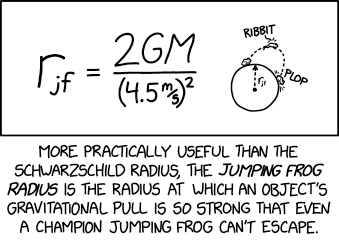
Transcript
[The panel shows a large formula to the left and a small drawing to the right. The formula's right side is drawn above and below the division line:]
rjf = 2GM / (4.5 m/s)2
[The drawing to the right shows a very small planet with the radius indicated with a labeled dotted arrow pointing from the center straight up to the edge of the planet. A frog is shown jumping on the surface. This is indicated with a parabolic dotted line going from a frog sitting on the surface near the top of the planet, up to the frog shown soaring through the air with its limbs stretched out about as high above the surface as the planet's radius. At this point the frog is making a sound. Then the dotted line goes down to about a quarter of the way around the planet where the frog lands making a noise, with lines around the frog representing the impact.]
Arrow label: rjf
Frog: Ribbit
Landing: Plop
[Caption below the panel:]
More practically useful than the Schwarzschild radius, the Jumping Frog Radius is the radius at which an object's gravitational pull is so strong that even a champion jumping frog can't escape.
(Sourced from explainxkcd.com)
Title text:Earth's r_jf is approximately 1.5 light-days, leading to general relativity's successful prediction that all the frogs in the Solar System should be found collected on the surface of the Earth.