#2908: Moon Armor Index
Permalink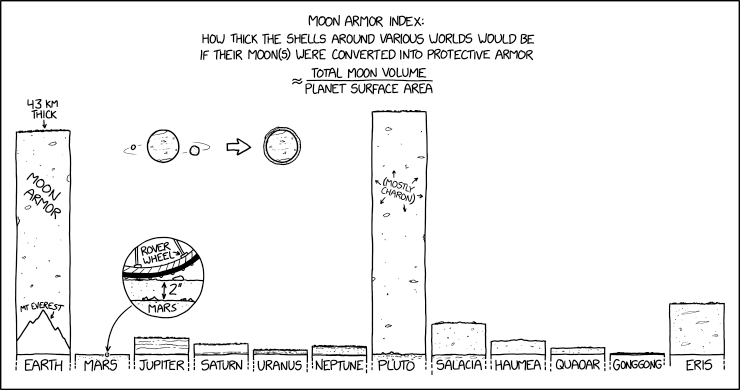
Transcript

|
This is one of 37 incomplete transcripts: Do NOT delete this tag too soon. If you can fix this issue, edit the page! |
[Text above diagram:]
Moon armor index:
How thick the shells around various worlds would be if their moon(s) were converted into protective armor
≈Total moon volume/Planet surface area
[Above the diagram, there is a depiction of two moons orbiting a planet, an arrow pointing right, and the same planet with an additional layer around it without orbiting moons.]
[The diagram consists of vertical bars showing "moon armor" thicknesses for (from left to right) Earth, Mars, Jupiter, Saturn, Uranus, Neptune, Pluto, Salacia, Haumea, Quaoar, Gonggong and Eris. Each bar is a different height, and they are listed as follows from shortest to tallest:]
[Mars' armor is not visible, though there is a diagram representing a zoomed-in portion of its armor, which is 2 inches (5 cm) thick, accompanied by a partial view of the wheel of a Mars Rover for scale.]
[Gonggong's armor is barely visible and appears to be slightly rocky.]
[Uranus' armor consists of a thin layer, which appears to be rocky.]
[Quaoar's armor is about 1.5 times the height of Uranus'.]
[Neptune's armor is about 1.5 times the height of Quaoar's, and has a rocky surface.]
[Saturn's armor is about 1.25 times the height of Neptune's, and has a rocky surface.]
[Haumea's armor is about 1.75 times the height of Saturn's.]
[Jupiter's armor is about 1.2 times the height of Haumea's, and has several strata running across it.]
[Salacia's armor is about twice the height of Jupiter's.]
[Eris' armor is about 1.3 times the height of Salacia's.]
[Earth's armor is about 4 times the height of Eris'.]
[Pluto's armor is about 1.05 times the height of Earth's.]
(Sourced from explainxkcd.com)
Title text:Astronomers are a little unsure of the applicability of this index, but NASA's Planetary Protection Officer is all in favor.